|
Many diagnostic tests are performed during the course of a
routine eye examination. Some of the more common instruments
used during these tests can be found in most optometric offices.
Brief descriptions of each of their functions are provided
below:
 Phoropter
A phoropter is an instrument that allows the doctor to
accurately determine a patient�s needed prescription for glasses
or contact lenses. As lenses of the phoropter are dialed in, a
patient is asked to respond which lenses yield clearer vision.
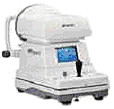 Auto-refractor
An auto-refractor is a computerized instrument which estimates
the needed prescription power of the lenses. It is valuable in
that it gives the doctor a quicker starting point to begin the
refraction with the phoroptor.
 Tonometer
Tonometers are used to measure pressure on the inside of the eye
and screens for certain conditions, such as glaucoma.
 Automated visual field testing
Automated visual field testing can detect a multitude of
problems found in the eyes or in the brain. Problems such as
retinal detachments, strokes of the optic nerve and in
associated structures, brain tumors, and aneurysms can all be
detected by the use of this advanced test.
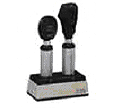 Ophthalmoscope
The doctor uses this instrument to obtain a 2-dimensional view
of the posterior aspects of the eye - namely the retina and
optic nerve.
 Digital Imaging
Digital imaging allows the doctor to take digital photographs of
the anterior and posterior structures of the eyes to help
document disease and pathological changes. These digital
computer images can be saved into the patient�s file for future
reference and comparison. They can be e-mailed to specialists
around the country for consultation.
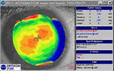 Computerized Corneal Topography
Computerized corneal topography creates a detailed topographical
computerized mapping of the front surface curvature of the
cornea. This highly technological tool is essential in
diagnosing multiple corneal pathologies.
|